
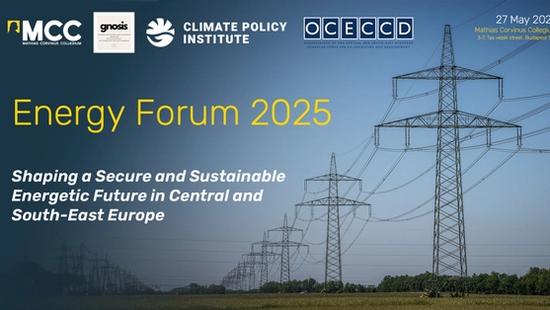
Energy Forum 2025: Shaping a Secure and Sustainable Energetic Future in Central and South-East Europe
conference organised by Gnosis Institute[1], OCECCD and the Climate Policy Institute
Date and venue:
27 May 2025 Budapest Center of Matthias Corvinus Collegium (1113 Budapest, Tas vezér u. 3-7.)
The conference will be held in English.
The event is public, but registration is required. Please register yourself by 25 May 2025 here: https://klimapolitikaiintezet.hu/jelentkezes/energy-forum-2025
Concept notes
Green transformation has been the calling word in the European energy sector for many years. Meanwhile the energy crisis, the Russian-Ukrainian war, and the confrontations and conflicts in the Middle and Far East have significantly changed the international environment in which energy policy decisions are made and implemented. The countries of Central and South-East Europe – including Hungary and other EU member states as well as Western Balkan countries aspiring for EU membership – are facing multiple challenges in ensuring a secure and affordable energy supply to meet the demand of their societies and economies and addressing environmental concerns at the same time.
Their choices have broader strategic relevance too. The EU integration of the Western Balkans – a region burdened with historical grievances – has security, economic and political significance for both Central and South-East Europe and for the EU in general. The political and economic stability of the neighbourhood depends largely on the vision and opportunities that international institutions, alliances and major powers in the region offer.
The one-day conference aims to provide an overview of how new energy diversification efforts, and the planning of new supply routes affect Central and South-East Europe, what new international cooperations are being outlined, and to what extent these will foster further the integration and closer cooperation in this region. The conference will explore the prospects of the region in four thematic panels and report on the opportunities of the area in the light of the new global and regional challenges. A separate panel will address the challenges related to the implementation of the European Green Deal and the clean energy transition, and the prospective role of different technologies and solutions in the region. Another panel will also shed light on the socio-economic and environmental impacts of the different energy strategies.
The ‘Energy Forum 2025: Shaping a Secure and Sustainable Energetic Future in Central and South-East Europe’ will bring together representatives of governments and state agencies, energy companies as well as experts and researchers from the countries of Central and South-East Europe to share their ideas on these very important issues that will largely influence the future of energy security and development in the region in the future.
Agenda
Registration and arrival of guests (8:30-9:00)
Welcome remarks (9:00-9:20)
Erik Molnár
General Director
Gnosis Institute
Dr. Mónika Besenyei
Director
Climate Policy Institute
Going green while baby drills (9:20 – 11:00)
“Drill, baby drill” – Trump said, promising to re-strengthen the role of fossil energy resources and to cut energy prices. Meanwhile the EU is still facing the multi-faceted challenges to go green, provide affordable energy supply and to increase its competitiveness in the shadow of the war in Ukraine.
Keynote speech
András Jenei
Deputy Director
Centre for Fair Political Analysis
Panel discussion
Péter Holicza
Deputy State Secretary for EU Affairs & International Relations
Ministry of Energy, Hungary
H.E. Christo Polendakov
Ambassador of Bulgaria in Hungary
Leonita Shabani-Mullarama
Secretary General
Ministry of Economy of Kosovo
Moderated by
Erik Molnár General Director Gnosis Institute
Coffee break (11:00-11:20)
Helping hands of your neighbour (11:20-13:00)
Building regional connectivity in energy supply chains and trade is essential to create functional networks and to optimise the use of energy produced. Cross-border cooperation and strengthening good neighbourly relations in energy policy can contribute to inter-state trust and mutually benefit the countries in concerns. Companies and regulatory authorities implementing such cooperations are key to ensure their operation ability.
Keynote speech
Szabolcs I. Ferencz
Chairman of the Board & CEO
FGSZ Ltd.
Panel discussion
Pál Ságvári
Vice President
Hungarian Energy and Public Utility Regulatory Authority
Lidija Božić
Head of Production Department
Croatian Hydrocarbon Agency
Róbert Fehér
Vice President
Hungarian Renewable Energy Association
Moderated by
Dr. Ottó Toldi Senior Researcher Climate Policy Institute
Lunch break (13:00-14:00)
Sustainable and realistic: the future of green transformation (14:00-15:40)
While there is still a debate on that how realistic it is to create a more environmentally sustainable energy system, technological development contributes to the emergence of new energy resources which along with modernisation of “old solutions” are providing increasing number of competitive and complementary solutions to combat this complex challenge.
Keynote speech
Dalibor Arbutina
Director
Nuclear Facilities of Serbia
Panel discussion
Pál Kovács
Head of Cabinet and Director of CEO’s Cabinet
MVM Paks Nuclear Power Plant Ltd.
Dr. Alexandra Köves
Associate Professor
Department of Decision Sciences
Corvinus University of Budapest
Ljiljana Zornjak
Head of Geothermal Potential Development Department
Croatian Hydrocarbon Agency
Moderated by
Árpád Párducz
International Analyst
Institute of Energy Strategy
Coffee break (15:40-16:00)
Energy strategies and their socio-economic impacts (16:00-17:40)
While there is no one-size-fits-all solution, evaluation of energy strategies cannot be complete without the consideration of social, economic and environmental impacts. Although some of these aspects are hard to be numerated but definitely, they shall be part of the analysis of costs and benefits accompanying certain strategic choices.
Keynote speech
Rusif Huseynov
Director
Topchubashov Center, Azerbaijan
Panel discussion
Dr. Ottó Toldi
Senior Researcher
Climate Policy Institute, Hungary
Milan Antonijević
Independent consultant and human rights lawyer
Serbia
Agron Demi,
Director
Atlas Institute, Kosovo
Moderated by
Anna Orosz Head of Research Gnosis Institute
Closing remarks by the organisers (17:40-17:45)
[1] Gnosis Institute – Central and South-East European Institute for Sustainable Co-operation and Development is a Vienna-based, independent research institute founded by the Organization of the Central and South-East European Consular Corps for Co-Operation and Development (OCECCD).